


You type your own product category into ChatGPT. The answer names three competitors, quotes a Reddit thread, and links to a Wikipedia page. Your site, which sits on page one of Google for the same phrase, is not in it.
That gap is what this guide closes: to rank on ChatGPT Search Engine, you do not need a new kind of SEO; you need to fix the four things that decide whether ChatGPT can fetch your page and whether it is worth quoting once fetched. The same four things, with different crawler names, decide whether Perplexity, Google AI Mode, Gemini, Claude, and Copilot cite you, and this guide covers each of them.
The short answer: ChatGPT search only cites pages its own crawler, OAI-SearchBot, can fetch, and it pulls candidates from a blended index that still leans on Bing. Out of the tens of pages it fetches for one answer, it cites a handful, and those winners share four traits: they answer one question in the first two or three sentences of a section, they contain specific numbers, names, and dates, they are corroborated on other domains (Reddit and Wikipedia above all), and they were updated recently. Get those four right, in that order, and you are competing for the citation. Skip the first one and nothing else matters.
TL;DR
- OAI-SearchBot decides whether you can appear in ChatGPT search. Blocking GPTBot doesn’t affect it; blocking OAI-SearchBot removes you from answers entirely (OpenAI’s crawler documentation).
- ChatGPT reached 900 million weekly users in February 2026, but citations appeared in only about 6.8% of US prompts in May 2026 (Similarweb). Most answers cite nothing.
- Reddit takes 16.8% of ChatGPT citations and Wikipedia 7.0% (Ahrefs, September 2026). Being mentioned there matters more than one more backlink.
- The optimizations with measured lift are adding statistics, quotations, and cited sources: up to 40% more visibility in the Princeton GEO study. Keyword stuffing did nothing.
- llms.txt has no confirmed effect. No AI provider has said it reads the file at answer time.
- ChatGPT sent 0.32% of global website referrals in May 2026, an all-time high (SE Ranking). Worth doing, not worth abandoning Google for.
- The other engines overlap little: 79.6% of cited sources appear on only one engine (Wellows). Allow OAI-SearchBot, PerplexityBot, Claude-SearchBot, and Claude-User; Google AI Overviews, AI Mode, and Gemini run on Googlebot, and Copilot on Bingbot.
What changed since this guide was first written?
When this post went live in November 2024, ChatGPT search had been public for eight days and OpenAI had not published a line about how it picked sources. Almost everything written about “ChatGPT SEO” at the time, this post included, was extrapolated from Google. Three things are different now, and each one changes the advice.
First, scale, which is why the question of how to rank on ChatGPT Search Engine went from niche to mainstream. OpenAI reported 900 million weekly active users and 50 million paying subscribers on February 27, 2026, up from 800 million the previous October (TechCrunch). Search is on by default for those users; the model decides when to look things up.
Second, documentation. OpenAI now publishes exactly which crawler does what (OpenAI crawler overview), and a publisher FAQ that says any public site can appear in ChatGPT search as long as OAI-SearchBot is not blocked (Publishers and Developers FAQ). No ranking algorithm is still published, but the access rules are no longer guesswork.
Third, measurement. Two years of citation studies now exist, and referrals are tracked utm_source=chatgpt.com automatically, so you can see in Google Analytics whether any of this is working. The rest of this guide is built on those three things rather than on Google habits.
How does ChatGPT search decide what to cite?
ChatGPT search decides what to cite in four stages, and only the first one is fully documented: crawl, retrieve, fetch, select. OAI-SearchBot crawls pages it is allowed to reach and feeds OpenAI’s own index; that index is blended with Bing’s results and other third-party providers, and practitioners who log crawler traffic report that Bing supplied the original index and still contributes, though it is no longer the only source (Lemniscate Growth’s breakdown).
When you ask a question, the model rewrites it into several shorter queries, typically three to eight, each aimed at a different facet of the question. It retrieves tens to low hundreds of candidate documents across those queries, fetches them, reranks them, and quotes a handful. One analysis of 30 million sources found ChatGPT evaluates about 2.5 times more sources than it cites, and only 39.5% of fetched sources end up in an answer (Peec AI, via SaaSy Links’ seven-study roundup).
That funnel is the whole game. There is no position one. A Sources panel shows a few links, and your page is either in it or it isn’t. Everything below is about surviving each stage of the funnel, because the Sources panel is the only ranking that exists.
Traditional SEO vs ChatGPT SEO: what actually differs
Most of what works on Google still works here, because Bing’s index is part of the pipeline and Bing rewards the same fundamentals. The differences are in what happens after retrieval.
| Factor | Google search | ChatGPT search |
|---|---|---|
| Unit of competition | A ranked URL | A quotable passage inside a page |
| Crawler that matters | Googlebot | OAI-SearchBot (plus Bingbot for the shared index) |
| What “winning” looks like | Position 1 to 3 | One of roughly 3 to 8 cited sources |
| Backlinks | Strong signal | Weak signal; 77% of cited sources have a domain authority under 50 (Wellows, 2.37M citations) |
| Third-party mentions | Indirect | Direct: Reddit and Wikipedia alone take about 24% of citations |
| Freshness | Query-dependent | Strong on fast-moving topics, roughly a 12 to 18 month window |
| Engagement metrics | Debated | No evidence ChatGPT sees them; it fetches pages, it does not watch visitors |
| Structured data | Rich results | Helps Bing understand the page; no confirmed effect on ChatGPT’s choice |
| Traffic outcome | Clicks to the ranked page | Since May 2026, about six in ten referrals land on your homepage, not the cited page (Similarweb) |
The last row surprises people. ChatGPT’s May 2026 update added homepage links beside citations, and homepage referrals jumped from 26 to 29% of ChatGPT referrals to 62 to 63% (Similarweb AI search stats). Your homepage is now a landing page for AI traffic, whether you designed it that way or not.
How to rank on ChatGPT Search Engine in 9 steps
Do these in order. Steps 1 and 2 are pass or fail; the rest improve your odds.
Step 1: Let OAI-SearchBot in
Open your robots.txt and make sure nothing blocks OAI-SearchBot. OpenAI runs four crawlers with different jobs: OAI-SearchBot surfaces sites in ChatGPT search, GPTBot collects training data, ChatGPT-User fetches pages when a user clicks or asks for a live read, and OAI-AdsBot checks ad landing pages (OpenAI crawler overview). Blocking GPTBot does not affect your search appearance. Blocking OAI-SearchBot means, in OpenAI’s words, your site “will not be shown in ChatGPT search answers,” though it may still appear as a bare navigational link.
In WordPress with Rank Math, go to Rank Math → General Settings → Edit robots.txt. If you have ever pasted a “block all AI bots” snippet, it probably disallows OAI-SearchBot too. Keep the GPTBot block if you want to opt out of training, and add an explicit allow for the search crawler:
User-agent: OAI-SearchBot
Allow: /

User-agent: GPTBot
Disallow: /
Check two more places that override robots.txt. Cloudflare’s AI bot blocking, if switched on, can block search crawlers along with training crawlers; review the rule under Cloudflare’s AI Crawl Control and allow OAI-SearchBot there. And any security plugin with “block bad bots” turned on may be returning 403s to OpenAI’s IP ranges, which OpenAI publishes at openai.com/searchbot.json so you can verify hits in your server logs. OpenAI says it takes about 24 hours to notice the change.
Step 2: Get indexed by Bing, and tell it when you publish
Because Bing still feeds part of the candidate pool, a page Bing hasn’t indexed is invisible to the second stage, no matter how good it is. Verify your site in Bing Webmaster Tools (it can import your Google Search Console properties in one click), submit your XML sitemap, and check the URL inspection report for your key pages.
Then turn on IndexNow. Rank Math’s Instant Indexing module (Rank Math SEO → Instant Indexing → Settings) pings Bing the moment you publish or update a post, which is the fastest documented route into the index (Rank Math Instant Indexing). OpenAI has not published how long a newly indexed page takes to become citable, so treat anything you read about “48 hours” as anecdote. What you can control is that Bing knows about the page today rather than whenever it recrawls.
Step 3: Answer one question per section, in the first two sentences
The pages that win citations answer one question per section and put the answer in the first two or three sentences, before any context or caveats. That is the opposite of the “hook, then build up, then reveal” structure most blog posts use, and it is the single biggest editorial change on this site since 2024.
Phrase H2s as the literal question a person would type (“Does ChatGPT search use Bing or Google?”), Open with the answer as a self-contained sentence, then explain. The model fetches your page in pieces, and a passage that only makes sense with the paragraph above it loses to a competitor’s passage that stands alone. The SEO vs AEO explainer on this site covers the reasoning; this post follows that structure so you can see it in action.
Step 4: Put numbers, names, and dates in the text
The only peer-reviewed test of this is the Princeton and IIT Delhi paper “GEO: Generative Engine Optimization” (KDD 2024), which ran nine content changes through generative engines and measured source visibility. Adding statistics, adding quotations, and citing sources were the three methods that lifted visibility the most, up to 40%, while keyword stuffing produced no gain (Aggarwal et al., arXiv 2311.09735).
In practice, to rank on ChatGPT Search Engine, you replace “many users” with “900 million weekly users (OpenAI, February 2026)”, replace “recently” with the month, and name the tool, the study, and the person. An answer engine can quote a sentence with a number and a source without hedging. A sentence with an adjective is not.
Step 5: Get mentioned where ChatGPT already looks
Reddit is the single most cited domain in ChatGPT at 16.8% of citations, Wikipedia is second at 7.0%, and the rest of the top ten are Consumer Reports, Forbes, EngineerFix, LegalClarity, Healthline, YouTube, PubMed Central, and Walmart (Ahrefs Brand Radar, September 2026). Only Reddit and Wikipedia let you show up without owning the domain, and both punish self-promotion.
The practical version: answer questions in the subreddits your buyers use, with your real product named only when it is the honest answer; keep your company’s Wikipedia presence accurate if one exists; and publish original numbers other sites want to cite, because corroboration on other domains is one of the four traits cited pages share. Backlinks still count for Bing, but the citation studies keep finding that domain authority is a weak predictor: 77% of ChatGPT’s cited sources have a domain authority under 50 (Wellows, 2.37 million citations analyzed). Being the primary source for one specific fact beats being a big site with none.
Step 6: Keep a visible “updated” date and mean it
Recency matters on fast-moving topics. Practitioner tracking puts the useful window at roughly 12 to 18 months for topics like AI tools and software, and much longer for stable reference content. This post is a case in point: the 2024 version cited a 200-million-user figure that was wrong by a factor of four and a half by early 2026.
Set a refresh cadence by topic, not by calendar. Re-verify every number against its source, update the modified date (leave Lock Modified Date off in WordPress), and change the text where the facts changed rather than bumping the date on an untouched post. Dates without changes are what a fetched-and-compared page gets caught on.
Step 7: Use FAQ sections and clean headings; treat schema as a Bing signal
FAQ sections work because they are answer-first by construction: a question, then two to four sentences that stand alone. Every post on this site now ends with one. Add FAQPage schema through the Rank Math FAQ block so Bing understands the structure; there is no confirmed evidence that ChatGPT’s selection stage reads schema, so treat it as free Bing insurance rather than a ChatGPT lever.
The on-page SEO checklist here still applies for headings, internal links, and image alt text, because Bing indexing is stage two of the funnel and those fundamentals are how you pass it.
Step 8: Make your homepage answer “what is this?”
Since ChatGPT started adding homepage links next to citations in May 2026, roughly six in ten referred visits land on the homepage rather than the cited article (Similarweb). A homepage that opens with a slogan and a hero image loses those visitors. Put a one-sentence description of what the site is and who it is for above the fold, link the three or four pages ChatGPT is most likely to cite, and check that the page loads fast on mobile, because that is the device most ChatGPT sessions run on.
Step 9: Measure it, then iterate
Referrals from ChatGPT arrive with utm_source=chatgpt.com appended automatically, so build a Google Analytics 4 exploration filtered on that source and watch landing pages and conversions. Keep a fixed list of 20 to 30 prompts your buyers would ask, run them in ChatGPT weekly, and log which domains get cited and whether yours is one of them. Ahrefs Brand Radar and Semrush’s AI toolkit automate this, but a spreadsheet works for a single site.
If your server logs show OAI-SearchBot requests timing out or returning errors, fix that before anything else in this list; a crawler that cannot fetch the page cannot cite it. Run the page through PageSpeed Insights first. On WordPress, where the slow part is usually a plugin rather than the host, the ten-minute method for finding the plugin slowing down WordPress will locate it.
How do you get cited in Perplexity, Google AI Mode, Gemini, Claude, and Copilot?
The nine steps to rank on ChatGPT Search Engine carry over to every other AI engine, but each one has its own crawler to allow, its own index, and its own favorite sources, and the overlap between them is small. Across 22.7 million citations from January to June 2026, 79.6% of cited sources appeared on one engine and nowhere else, and Perplexity never touched 89.1% of the sites ChatGPT cited for the same question (Wellows citation overlap study). Treat each engine as a separate channel that rewards the same fundamentals.
| Engine | Crawler to allow (training crawler you may block) | Where answers come from | Most cited sources | Share of AI referrals, 2026 |
|---|---|---|---|---|
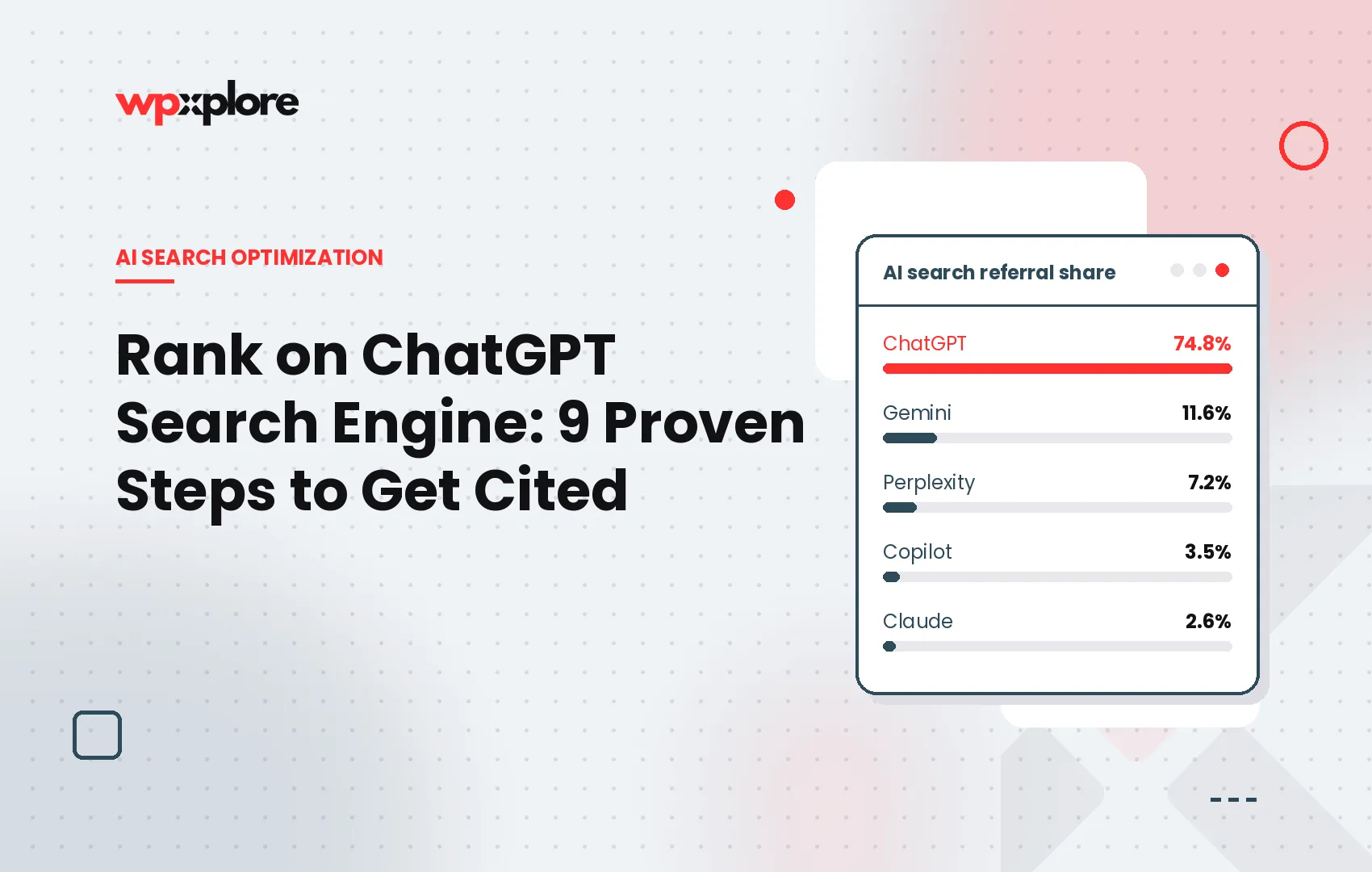
| ChatGPT search | OAI-SearchBot and ChatGPT-User (GPTBot optional) | Own index blended with Bing and third parties | Reddit 16.8%, Wikipedia 7.0% | 74.78% |
| Google AI Overviews and AI Mode | Googlebot (Google-Extended has no effect here) | Google’s index, with query fan-out | YouTube 22.9%, Reddit 18.5%, Facebook 10.1% | Counted as Google organic, not as AI referrals |
| Gemini app | Googlebot; Google-Extended controls grounding | Google Search grounding | Draws on Google’s ranked results | 11.56% (up 231% year on year) |
| Perplexity | PerplexityBot (Perplexity-User ignores robots.txt) | Own index plus live page fetches | Reddit 21.6%, YouTube 20.8%, Wikipedia 6.3% | 7.23% (flat) |
| Claude | Claude-SearchBot and Claude-User (ClaudeBot optional) | Own search index plus live fetches | No public citation study yet | 2.62% (up 320% year on year) |
| Microsoft Copilot | Bingbot | Bing’s index and ranking | Bing-ranked pages | 3.51% (up 31%) |
Citation shares are from Ahrefs Brand Radar, September 2026; referral shares are from SE Ranking’s study of 101,574 sites, January 2025 to April 2026 (SE Ranking). StatCounter’s March 2026 numbers tell the same story from a different sample: ChatGPT 78.16%, Gemini 8.65%, Perplexity 7.07%, Copilot 3.19%, Claude 2.91% (StatCounter).
Google AI Overviews and AI Mode
Google says you need nothing new to appear in AI Overviews or AI Mode, and for once the official line matches the data. Its optimization guide, updated July 2026, states that “you don’t need to create new machine-readable files, AI text files, markup, or Markdown,” that “there’s no requirement to break your content into tiny pieces,” and that structured data “isn’t required for generative AI search.” The one hard rule: a page “must be indexed and eligible to be shown in Google Search with a snippet,” so a nosnippet tag removes you from AI features entirely (Google’s AI optimization guide).
What did change is which pages get picked. In July 2025, 76% of pages cited in AI Overviews ranked in Google’s top 10 for the query; by March 2026 that had fallen to 38%, and 31% of citations came from beyond position 100 (Ahrefs, via Search Engine Journal). Ahrefs attributes it to query fan-out: Google splits the question into sub-queries and cites whoever answers each sub-query best.
So a page that ranks 40th for the head term but answers one specific sub-question in its first two sentences can be cited over the page ranking first. Step 3 is the whole strategy here.
Two more specifics. YouTube is the most cited domain in AI Overviews at 22.9%, ahead of Reddit at 18.5% (Ahrefs, September 2026), so a three-minute video version of your best guides, embedded in the post, gives you a second shot at the same answer. And Google-Extended, the robots.txt token people block to opt out of AI, “does not impact a site’s inclusion in Google Search nor is it used as a ranking signal”; it only governs Gemini training and grounding (Google crawler documentation). Blocking it doesn’t remove you from AI Overviews, and allowing it doesn’t help you get in.
Search Console folds AI Overviews and AI Mode clicks into the normal Web performance report, so track impressions on the sub-questions rather than looking for a separate AI report.
Gemini
Gemini is now the second-largest AI referrer, at 11.56% of AI referral traffic and growing 231% year on year (SE Ranking), and it overtook Perplexity in March 2026 (StatCounter). It answers by grounding in Google Search, which means the Google fundamentals above are the entry ticket. The one difference is Google-Extended: Google’s documentation says the token controls whether your content may be used “for training future generations of Gemini models” and “for grounding.” If you disallow Google-Extended to stay out of training, you may also be opting out of being a Gemini source.
Decide that deliberately rather than by pasting a block list. Gemini referrals arrive with the referrer gemini.google.com, so add it to the same GA4 exploration as ChatGPT.
Perplexity
Perplexity runs two fetchers with opposite rules. PerplexityBot “is designed to surface and link websites in search results on Perplexity” and “is not used to crawl content for AI foundation models”; it respects robots.txt. Perplexity-User fetches a page when a user asks a question that needs it, and Perplexity’s own documentation says “this fetcher generally ignores robots.txt rules,” so it can only be controlled at the firewall using the IP ranges Perplexity publishes at perplexity.com/perplexity-user.json (Perplexity crawler docs). Allow PerplexityBot and you are in the index; block it and you can still be fetched live but will not be surfaced from search.
Perplexity is the most community-driven engine: Reddit takes 21.6% of its citations and YouTube 20.8%, 42.4% between them, with Wikipedia a distant third at 6.3% (Ahrefs, September 2026). It also shows numbered citations inline, one per claim, so a paragraph that makes three claims with three sources gets three chances to be cited, while a paragraph of unsourced opinion gets none. Its referral traffic has stalled: flat globally, and its US share of AI traffic fell from 11.42% in 2025 to 6.85% in 2026 (SE Ranking). Worth being present in, not worth building for.
Claude
Claude is the fastest-growing AI referrer by percentage: up 320% year on year, with a 159% jump in March 2026 alone (SE Ranking), from a small base of 2.62%. Anthropic documents three bots, updated April 7, 2026: ClaudeBot collects training data, Claude-User “may access websites” when a person asks Claude a question, and Claude-SearchBot “navigates the web to improve search result quality.” All three respect robots.txt, and Anthropic says blocking Claude-User or Claude-SearchBot “may reduce your site’s visibility” in Claude’s answers, while blocking ClaudeBot only affects training (Anthropic crawler documentation). The verified IP list is at claude.com/crawling/bots.json.
There is no public study of Claude’s citation preferences yet, so treat it like ChatGPT: allow the two non-training bots, keep the answer in the first two sentences of each section, and make sure the page’s text is present in the HTML rather than rendered only by JavaScript, because live fetchers read what the server sends.
Microsoft Copilot
Copilot grounds its answers in Bing’s index and Bing’s ranking, so if you completed Step 2 you have already done the work. Verify the site in Bing Webmaster Tools, keep IndexNow on, and treat Bing’s ranking for your key pages as your Copilot visibility. Copilot delivers 3.51% of AI referrals, growing 31% a year (SE Ranking), and it sits inside Windows, Edge, and Microsoft 365, which skews its audience toward business users.
One robots.txt for all of them
This block allows every search and user-fetch crawler while excluding the two training crawlers, which have no effect on search visibility. Remove the Google-Extended lines if you want to stay eligible for Gemini grounding.
User-agent: OAI-SearchBot
Allow: /

User-agent: ChatGPT-User
Allow: /

User-agent: PerplexityBot
Allow: /

User-agent: Claude-SearchBot
Allow: /

User-agent: Claude-User
Allow: /

User-agent: GPTBot
Disallow: /

User-agent: ClaudeBot
Disallow: /
Googlebot and Bingbot need no lines; they are allowed by default, and you should never block them. After editing, watch your server logs for a week and confirm each allowed agent actually reaches a 200 response, because a firewall or a CDN rule can override robots.txt without telling you.
What does not work
Three pieces of advice about how to rank on ChatGPT Search Engine circulate widely with no evidence behind them, and one of them is in the 2024 version of this post.
llms.txt does nothing you can measure. The proposed file that summarizes your site for language models has been adopted by thousands of sites, and no AI provider, OpenAI included, has confirmed that its assistant reads it at answer time; crawlers fetching the file proves it is reachable, not that it is used (llmtxt.info, updated August 2026). It is harmless. It is also not a step.
Engagement signals are not a ChatGPT ranking factor. The earlier version of this guide told you to improve click-through rate and time on page to rank in ChatGPT. No mechanism supports that: ChatGPT fetches your page through a crawler and never sees your visitors. Engagement matters for readers and, indirectly, for Google. It does not matter for citation selection.
Keyword density is not a lever. The GEO study measured keyword stuffing directly and found no visibility gain. Use the phrase people actually ask, once in the title, once in the opening, once in a heading, and then write normally.
Is it worth the effort to rank on ChatGPT Search Engine?
For most WordPress sites, it is worth an afternoon of fixes and a monthly check, not a strategy rewrite. ChatGPT sent 0.32% of global website referral traffic in May 2026, an all-time high and a 36.7% jump in one month, and it still accounts for about 76% of all AI-assistant referrals worldwide (SE Ranking, 101,574 sites). That is small next to Google and growing faster than anything else in your referral report.
The upside is uneven. Citation presence in US prompts was about 6.8% overall in May 2026, but roughly 23% in travel and hospitality and 20% in automotive, and under 4% in professional services (Similarweb). If you sell hosting, plugins, or directory software, expect answers with citations to be the minority and treat each one as a high-intent visit rather than a traffic channel. If you are still deciding whether AI search deserves your attention, the piece on why Google search is falling apart makes the longer argument.
What to do this week
Open robots.txt and confirm OAI-SearchBot is allowed, verify the site in Bing Webmaster Tools and switch on Rank Math’s Instant Indexing, then rewrite the first two sentences under every H2 of your five most important posts so each one answers its heading outright. Those three changes cost an afternoon and cover the two pass-or-fail stages plus the trait cited pages share most, which is as close to a formula to rank on ChatGPT Search Engine as the evidence supports. Everything else in this guide compounds on top of that base.
One more check while the logs are open: if any of the allowed crawlers are timing out, fix server response time before publishing anything new. PageSpeed Insights will show the symptom, and a free read-only performance audit such as BoltAudit will map the server time back to the WordPress plugin responsible without deactivating anything. It will not tell you whether any engine cited you; only your prompt log does that.
FAQ
Does ChatGPT search use Bing or Google?
ChatGPT search uses a blended index: OpenAI’s own crawler (OAI-SearchBot) builds an index that combines results from Bing and other third-party providers. It does not use Google. Bing supplied the original index in 2024 and still contributes, which is why Bing Webmaster Tools is the closest thing to a ChatGPT search console.
Do I need to allow GPTBot to appear in ChatGPT search?
No. GPTBot only collects training data, and OpenAI says blocking it doesn’t affect search appearance. OAI-SearchBot controls search visibility. You can block GPTBot and allow OAI-SearchBot in the same robots.txt file.
Does llms.txt help me rank on ChatGPT Search Engine?
No measurable effect has been shown. As of August 2026, no AI provider has confirmed reading llms.txt at answer time, and a crawler fetching the file only proves it is reachable. Publishing one is harmless, but it is not one of the nine steps.
How long does it take for a new page to appear in ChatGPT search?
OpenAI has not published a timeline. What is documented: robots.txt changes take about 24 hours to be reflected, and Bing indexing is a prerequisite for the shared part of the index, so pinging Bing through IndexNow on publish is the fastest step you control. Practitioners report days to weeks for a newly indexed page to be cited.
Does schema markup help ChatGPT cite my page?
Schema helps Bing understand your page, and Bing indexing is part of ChatGPT’s pipeline, so it is worth adding FAQPage and Article schema. No confirmed evidence shows that ChatGPT’s selection stage reads schema directly. Treat it as Bing insurance, not a ChatGPT ranking factor.
How do I track traffic from ChatGPT?
Referrals from ChatGPT automatically carry the parameter utm_source=chatgpt.com. In Google Analytics 4, filter sessions by that source to see landing pages, engagement, and conversions. Since May 2026, about six in ten of those visits land on the homepage, so include it in your landing-page report.
Does ranking on Google guarantee ChatGPT citations?
No. ChatGPT draws from a different index and selects passages rather than URLs, and 77% of its cited sources have a domain authority under 50. A page-one Google ranking helps with Bing indexing but does not decide whether your passage gets quoted; to rank on ChatGPT Search Engine, you need answer-first structure and specific, sourced facts.
How often does ChatGPT actually show citations?
Rarely, still. Citations appeared in about 6.8% of US ChatGPT prompts in May 2026, up from 1.6% in June 2025, with travel at roughly 23% and professional services under 4%. Most answers are generated without sources, so a citation is a high-intent visit rather than a volume channel.
Does the same page get cited in ChatGPT, Perplexity, and Google AI Overviews?
Usually not. Across 22.7 million citations from January to June 2026, 79.6% of cited sources appeared on only one engine, and Perplexity never touched 89.1% of the sites ChatGPT cited for the same question (Wellows). Each engine has its own index and favorite sources, so check your visibility in each one separately.
Which crawlers do I need to allow for AI search?
Allow OAI-SearchBot and ChatGPT-User for ChatGPT, PerplexityBot for Perplexity, Claude-SearchBot and Claude-User for Claude, and never block Googlebot or Bingbot, which serve Google AI Overviews, AI Mode, Gemini, and Copilot. GPTBot and ClaudeBot collect only training data and can be blocked without losing search visibility; Google-Extended affects only Gemini training and grounding.
wpXplore is published by BetterDots, which also makes BoltAudit.


Leave a Comment